
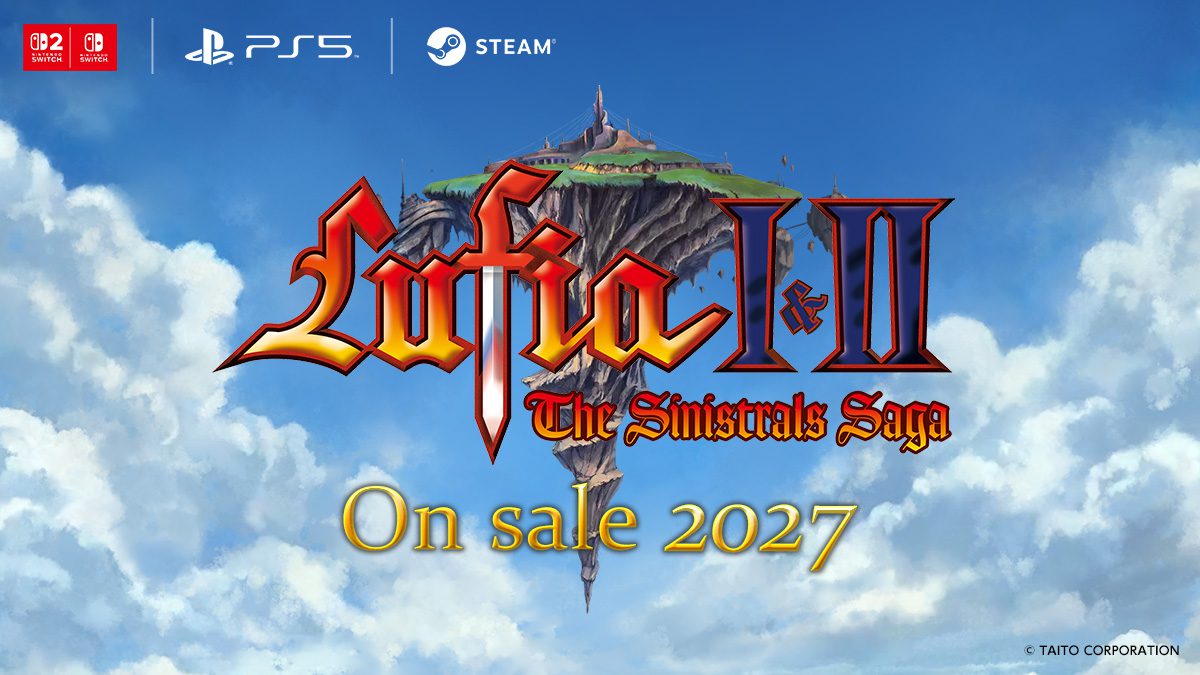
I bought Lufia II in 1996 thinking it was a sequel. I played forty hours before I understood it was a prequel, and I have never trusted a box since (the European release just called it Lufia, which did not help). Both games are coming back. Clear River Games and Taito announced Lufia I & II: The Sinistrals Saga on Sunday at PC Gaming Show Tokyo. It arrives digitally in 2027 on Steam, PlayStation 5, Nintendo Switch and Switch 2, with physical editions to be announced later.

The originals were Neverland’s. Lufia & the Fortress of Doom shipped on the Super Nintendo in 1993, published by Taito in Japan (as Estpolis Denki) and by Taito’s American arm in the US. Its prequel, Lufia II: Rise of the Sinistrals, followed in 1995. Together they tell one story across generations: a family of heroes against the Sinistrals, four god-tier villains with a habit of coming back. The first game also did something few 1993 RPGs dared, as Clear River’s own team points out on the teaser site. It opens at the tragic end, credits and all, and it was one of the earliest console RPGs with a new game plus.
Lufia II held up, almost all of it. Neverland took the random-encounter dungeon crawl every 1995 RPG was built on and threw it out. Enemies are visible in dungeons and move when you move, so you can plan around them. The dungeons are puzzle boxes, closer to Zelda than to Final Fantasy. The Ancient Cave is a 99-floor bonus dungeon that resets you to level one and rerolls itself every visit. That is a roguelike hiding inside a console RPG, years before that became a habit. It still plays like something made ten years later than it was.
Lufia I is a 1993 RPG, and you know what that means. Random battles every few steps, a grind curve tuned for a rental, dungeons that are corridors with treasure. It matters because the two games share a world and a family tree, and Fortress of Doom is where the story of the first game’s heroes actually ends. People who play II first, which is the better idea, hit a wall when they go back.
What “enhanced for modern play” means so far
Taito’s teaser site says the release preserves the original pixel art and adds new functions, without listing them, and Time Extension notes the word remaster is absent. What is confirmed is more interesting than a filter. Series designer Masahide Miyata went back through every line of both games to rewrite the script in kanji, since the SNES cartridges had room mostly for hiragana. He says on the site that he reread all of it, embarrassment included (his word, roughly). The later Game Boy Color, Game Boy Advance and DS entries are not part of the package, so this is a two-game set, not a series collection.
Lufia I needs an encounter toggle and a fast-forward button. Whether the new functions include those, or stop at save states and rewind, is the question that decides the first game’s fate.
Lufia II is the one to play, in any version, and this will be the easiest legal way to do it in years. I will buy the collection for II and hope the new functions rescue I. This time I will read the box twice.